Water as One Sheet
October 6, 2026 • Provincia Dev Team

Water used to read as a grid of flat teal tiles. Ponds stepped at cell edges, ditches looked painted per quad, and cliff drops were solid walls. This ship is visual only — the CA is untouched — but the surface finally looks like one body of water.
Depth and shore without the tile
The surface shader blurs wet depth across neighboring cells and measures meters to the nearest dry bank instead of a per-cell edge test. Color grades shallow teal into deep navy, alpha softens at the shore, and dry texels no longer punch a dark cross through the middle of a pool. Still water gets a slow drift so the sheet is alive without looking like a river.
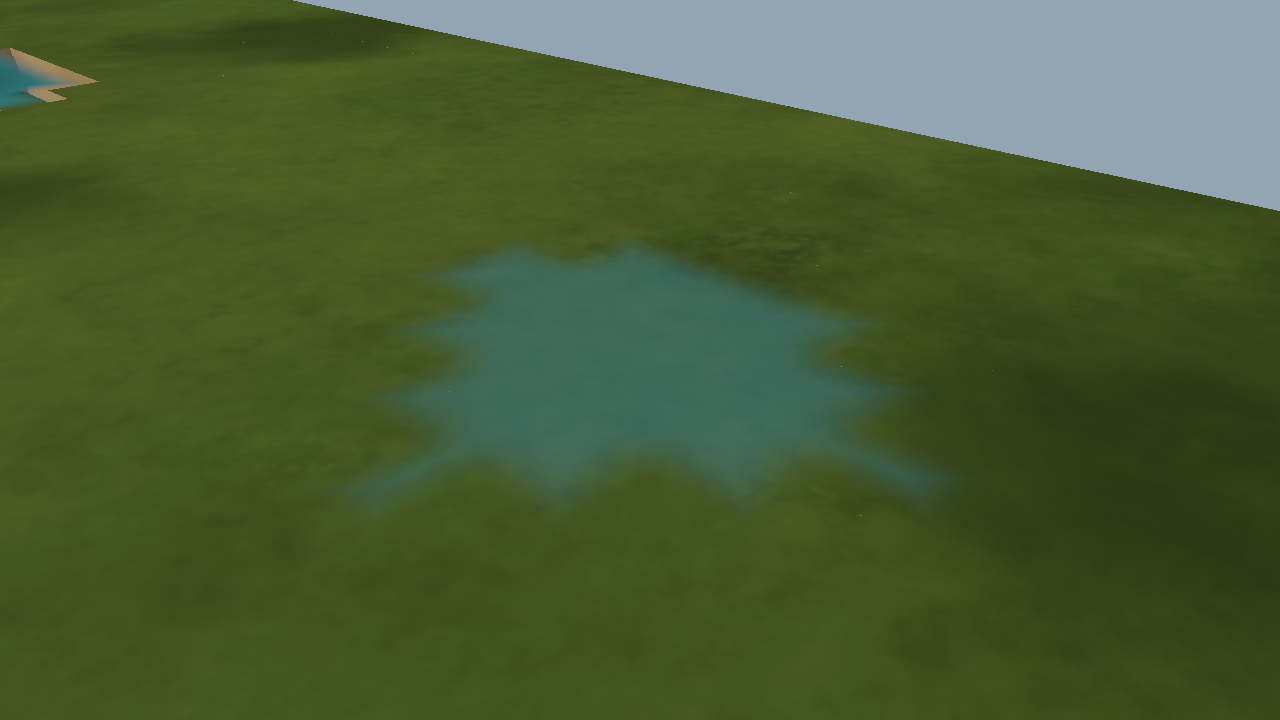
Ditches with downhill lanes
Channel water samples a neighborhood flow vector so long ditches pick up downhill lanes instead of a flat fill. Depth and shore stay continuous along the cut, so a trench reads as one ribbon rather than a stack of wet quads.

Falls you can see
Where the surface drops onto a lower wet neighbor, edge sheets sit on the low side of the step — in front of the dirt, not inside it — with vertical gaps and streak so they read as a fall instead of a solid cyan wall.

Aqueduct troughs keep their lips
Trough water in aqueduct channels keeps the same surface language without swallowing the stone lips. The polish is shared; the mesh builders still respect the trough bounds.

What to feel in a build
- Dig or place a pond and orbit it — the bank should fade smoothly, not stair-step per cell.
- Cut a long ditch downhill — look for continuous depth and faint lanes along the flow.
- Overflow a ledge — the fall sheet should hang in front of the cliff with vertical gaps.
- Fill an aqueduct trough — water should sit inside the stone, not erase the lips.